



Infusion therapy delivers medication directly into your bloodstream through an IV, allowing powerful biologics and other treatments to work faster and more precisely than pills alone. For patients with autoimmune and inflammatory conditions like rheumatoid arthritis or lupus, infusions are often recommended when oral medications haven’t provided enough relief. If your rheumatologist has mentioned infusion therapy, here’s what you need to know.
How Infusion Therapy Works
Unlike pills or injections you give yourself at home, infusion therapy is administered intravenously in a clinical setting, typically over the course of 30 minutes to a few hours, depending on the medication. A nurse monitors you throughout the session, and most patients tolerate infusions very well. Treatments are usually given on a scheduled cycle: every few weeks, every few months, or even once a year, depending on which medication is used.
The controlled clinical environment also allows your care team to catch and manage any infusion reactions quickly, making it a safe option even for complex or high-risk cases.

Benefits of Infusion Therapy
One of the most practical advantages of infusion therapy is convenience. Many infused biologics are dosed far less frequently than daily pills or weekly self-injections, some require treatment only once every four to eight weeks, and others like zoledronic acid (Reclast) are given just once a year. For patients managing busy schedules, needle anxiety, or difficulty adhering to daily medication routines, that reduced frequency can make a meaningful difference in long-term treatment success.
Conditions Commonly Treated With Infusion Therapy
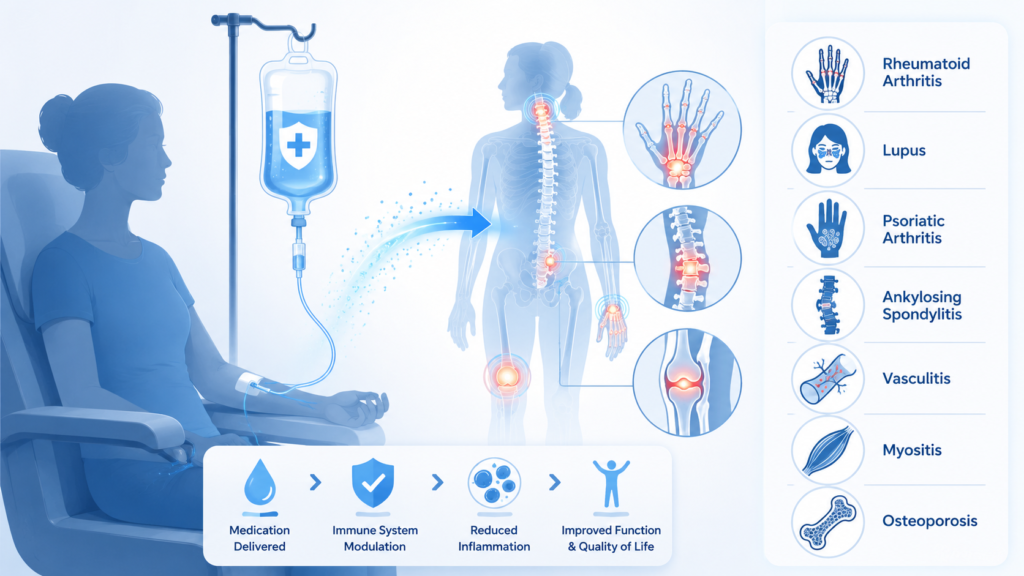
Infusion therapy is used across a wide range of autoimmune and musculoskeletal conditions. At Comprehensive Rheumatology Center, we commonly use infusions to treat:
- Rheumatoid Arthritis (RA) — when conventional DMARDs like methotrexate haven’t provided adequate disease control
- Psoriatic Arthritis — particularly for patients with active joint involvement and skin disease
- Ankylosing Spondylitis / Axial Spondyloarthritis — to reduce inflammation in the spine and sacroiliac joints
- Lupus (Systemic Lupus Erythematosus / SLE) — especially in patients with kidney involvement or refractory disease
- Vasculitis — including ANCA-associated vasculitis and giant cell arteritis (GCA)
- Inflammatory Myositis — including polymyositis and dermatomyositis
- Osteoporosis — for patients who cannot tolerate oral bisphosphonates or need once-yearly dosing
Medications Used in Rheumatology Infusion Therapy
Biologic Infusions
Biologics are targeted therapies that interrupt specific pathways driving inflammation. The most commonly infused biologics in rheumatology include:
- Infliximab (Remicade) — a TNF inhibitor used for RA, psoriatic arthritis, and ankylosing spondylitis
- Abatacept (Orencia) — a T-cell co-stimulation blocker used for RA
- Rituximab (Rituxan) — a B-cell depleting therapy used for RA, vasculitis, and lupus
- Tocilizumab (Actemra) — an IL-6 inhibitor used for RA and giant cell arteritis
- Belimumab (Benlysta) — a BAFF inhibitor approved for lupus, including lupus nephritis
- Anifrolumab (Saphnelo) — a newer biologic for moderate-to-severe lupus
Other Infusion Treatments
- IV Methylprednisolone (Solu-Medrol) — high-dose corticosteroid infusions for acute flares
- IVIG (Intravenous Immunoglobulin) — used in myositis and certain autoimmune neuropathies
- Zoledronic Acid (Reclast) — an annual infusion for osteoporosis in patients at high fracture risk
Who Is a Good Candidate for Infusion Therapy?
You may be a candidate for infusion therapy if:
- Your condition has not responded adequately to oral medications like methotrexate, hydroxychloroquine, or sulfasalazine
- You have moderate-to-severe disease activity that requires more aggressive treatment
- You experience side effects or absorption issues with oral or self-injectable biologics
- Your rheumatologist has identified a biologic target that is best delivered intravenously
Infusion therapy is not one-size-fits-all. Your rheumatologist will weigh factors including your diagnosis, disease severity, other medications, insurance coverage, and personal preferences before recommending a specific treatment.
What to Expect at Your Infusion Appointment
Most infusion sessions follow a simple process:
1. Check-in and vitals — your blood pressure, temperature, and weight are recorded

2. IV placement — a nurse places a small IV catheter, usually in your forearm

3. Pre-medication (if needed) — some biologics require an antihistamine or steroid beforehand to reduce infusion reaction risk

4. Infusion — the medication is administered slowly over the prescribed timeframe

5. Observation period — you'll be monitored for 15–30 minutes after the infusion before discharge
Bring something to read, a snack, or headphones, many patients find the time a good opportunity to decompress.
Is Infusion Therapy Covered by Insurance?
Many biologic infusions are covered under the medical benefit (rather than the pharmacy benefit) of most major insurance plans, including Medicare and commercial insurers. Coverage and prior authorization requirements vary by plan and medication. Our team will verify your benefits and work with your insurance to obtain approval before your first infusion.
Schedule a Consultation
If you’ve been living with persistent joint pain, inflammation, or an autoimmune condition that hasn’t responded well to standard treatments, infusion therapy may be worth discussing with a specialist.
Patients in Woodland Hills and the San Fernando Valley can schedule a consultation with our board-certified rheumatologists at (818) 598-0000.